Interview Transcript
Tim:
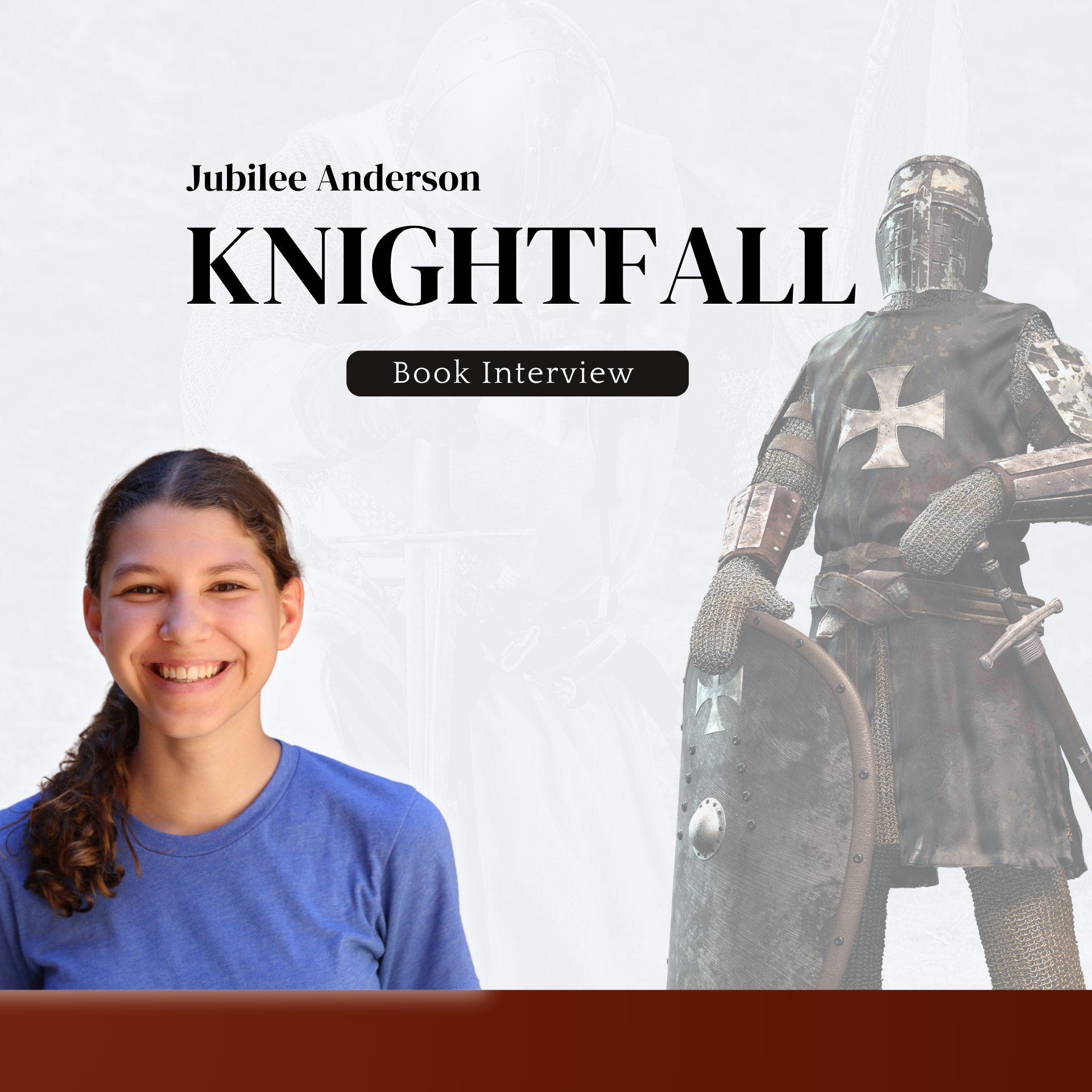
Today I’m interviewing Jubilee on her book Knightfall. So Jubilee, tell me about your new book, Knightfall.
Jubilee:
Knightfall is a YA medieval fantasy, and it’s about this knight named Marcus who goes on an extremely urgent assignment to save the noble and his family from an attacking army. He needs to warn them before the army comes. And so the story follows him and tells whether he’s successful or not.
Tim:
Sounds interesting. So your motivation for writing this story—tell me a little bit about how did this even start?
Jubilee:
So a long time ago—well, it wasn’t actually that long ago, about a year and a half ago—I was reading with my mom. She has this curriculum that she does with us, and she reads us stories from literature. Some of them are not stories, some are poems. One of these poems was called The Listeners by Walter de la Mare.
The poem is about a knight who goes up to a castle and knocks on the door, and no one answers him. But it’s implied that there are ghosts inside listening. The knight ends up turning around and walking away. That was the original inspiration for the story.
The second inspiration was the Wingfeather Saga. There’s a plot twist at the end of that series, and I thought it was such a cool way to end a story. I didn’t want to copy it, but I wanted to end mine similarly—with a twist.
Tim:
Yeah, that’s fun. So when you started doing this, did you have people who helped you get your first version of the story put together, or did you do that mostly on your own?
Jubilee:
The first draft, I did mostly on my own. I wrote through the whole thing, and then I joined this online writing community. That was the first time I’d ever seen other writers in a group, critiquing each other’s work and helping each other grow.
Tim:
So did you already have a version of the book before you joined this community?
Jubilee:
Yeah, I did. Once I joined, I started learning a lot. I joined a critique group and submitted the story, and they gave me some amazing feedback. It was super helpful.
Tim:
What kinds of things did you hear from that group? What was one or two of the most helpful things?
Jubilee:
It’s hard to remember everything because I’ve gone through so many drafts.
Tim:
How many drafts have you gone through at this point?
Jubilee:
Seven drafts.
Tim:
Wow, that’s a lot.
Jubilee:
Yeah. One major thing they pointed out in the first draft was that I had missing pieces. There would be a character that would appear in one scene, then disappear, and then randomly reappear a few scenes later when I needed him. That was a mistake I had to fix.
Tim:
What do they call that—scene continuity or something?
Jubilee:
We usually just call it consistency throughout the story.
Tim:
Okay, yeah. That makes sense. So now that you’re on your seventh draft, what have you learned by going through all of them? And what would you do differently if you wrote the first draft again?
Jubilee:
There’ve been huge changes since that first draft. The original was about 50 pages. Now it’s around 100. So it’s doubled.
Tim:
Is that because of added descriptions, or just more natural story progression?
Jubilee:
This is something I would do differently next time. I’m a huge plotter. I like to plan my story from the beginning, middle, to end. I recently learned a new way to structure a story that significantly improved the seventh draft. It would’ve saved me a lot of time early on.
If the foundation isn’t strong or shaped right, it’s hard to build on. And by shape, I mean the story arc.
Tim:
So you were missing part of the arc originally?
Jubilee:
Yeah, the middle was missing. The beginning was great, the ending was awesome, but the middle sagged. Not much happened. That’s why the random character showed up—to fill space. But at the time, I didn’t understand how important the middle is. You can’t just have a character believe one thing the whole story, then suddenly change at the climax. The middle helps show the gradual change that makes the ending believable.
Tim:
Nice. So what are your plans for the book from here on out?
Jubilee:
I’m hoping this is the final revision—or at least close. If not, there’ll be an eighth revision. That one will focus more on sentence structure and grammar. Right now I’m basically rewriting the whole thing, but I’m excited. It’s looking good.
Tim:
So once you complete it, what are your publishing plans?
Jubilee:
Right now I’m planning to offer it for free to people who sign up for my email list on my website. If you sign up before March, (Edit: I actually released it in May) you’ll still get it when it comes out in March.
Tim:
That’s great. So where do people go to find the book?
Jubilee:
You can go to my website: jubileeanderson.com. There’s a pop-up to subscribe, and if you scroll down on the front page, there’s also a sign-up form.
Tim:
Awesome. For people out there who are thinking about writing a book—how many hours would you say you’ve spent writing Knightfall?
Jubilee:
A lot. Definitely more than 100. Probably around 500. I write every single morning for at least an hour, sometimes more.
Tim:
So if you’re excited to write a book, get ready for about 500 hours. But of course, this is one of your earlier books.
Jubilee:
Yeah. I’m hoping the next one goes faster.
Tim:
That’s exciting. Do you have another book planned?
Jubilee:
I do. I have several ideas in the brainstorming stage.
Tim:
Do you have a title yet?
Jubilee:
Not yet. I have three or four ideas, and I’m not sure which one to start.
Tim:
Do you have a favorite idea?
Jubilee:
Yeah, I just came up with one the other day that’s kind of a medieval romance fantasy. I think it would be really cool to write.
Tim:
That’s exciting. Well, thanks so much for being here today.
Jubilee:
Thank you for having me, Tim.
Tim:
Talk to you soon.